
Durga Saptami
AssameseAlso known as: Saptami, Maha Saptami
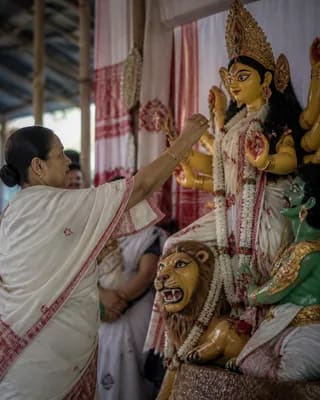
Durga Saptami
About Durga Saptami
Durga Saptami is the seventh day of Shukla Paksha in Ashwin, marking the beginning of the main Durga Puja celebrations in Assam. It is the day when the goddess's divine presence is formally invoked into the idol through elaborate rituals.
The day begins with the Nabapatrika Snan, where nine sacred plants representing the nine forms of Durga are bathed in a nearby water body. These plants, including banana, turmeric, and coloquintida, are wrapped in a white saree with a red border and placed beside the Durga idol.
In Assamese pandals, the Saptami rituals are accompanied by the continuous beating of dhak drums, creating an atmosphere of intense devotion. Devotees visit pandals throughout the day, offering prayers and participating in cultural programmes.
Vrat Vidhi & Fasting Rules
Devotees observe a fast on Durga Saptami and participate in the Nabapatrika Snan and evening puja.
- Wake up before sunrise and proceed to the nearest water body.
- Participate in the Nabapatrika Snan (bathing of nine sacred plants).
- Visit the Durga pandal and offer morning prayers.
- Observe a fast and break it after the evening aarti.
Puja Samagri & Ritual Steps
- Gather the nine sacred plants and take them to a water body.
- Bathe the plants and wrap them in the white and red saree.
- Place the Nabapatrika beside the Durga idol in the pandal.
- Offer prayers, perform the evening aarti, and distribute prasad.
Frequently Asked Questions (FAQs)
Nabapatrika Snan is the ritual bathing of nine sacred plants representing the nine forms of Goddess Durga, performed on Durga Saptami morning.
The nine plants include banana, turmeric, coloquintida, pomegranate, Ashoka, rice paddy, arum, bilva, and manaka.
Note: All timings are represented in 24-hour notation in local time of the selected location with DST adjustment (if applicable).
Hours which are past midnight are suffixed with next day date. In Panchang, a day starts and ends with local sunrise.
Recommended Pages
Comprehensive annual Hindu calendar with tithis and festivals.
Detailed month-wise view of lunar tithis and celestial events.
Marathi Panchang and festive dates for the year.
Gujarati Vikram Samvat calendar and festivals.
Telugu calendar and festive Panchangam details.
Tamil solar calendar dates and monthly Panchangam.