
Jagaddhatri Puja
BengaliAlso known as: Jagaddhatri Pujo, Jagaddhatri
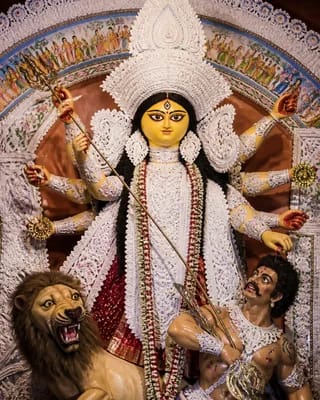
Jagaddhatri Puja
About Jagaddhatri Puja
Jagaddhatri Puja is celebrated on the ninth day of the bright fortnight of Kartik month (November), honouring Goddess Jagaddhatri, the sustainer of the world. The festival is particularly grand in Chandannagar and Krishnanagar in West Bengal.
The goddess is depicted riding a lion, holding a conch, discus, bow, and arrows, representing her power to protect the universe. Elaborate pandals are set up with beautifully crafted idols, often adorned with intricate decorations and lights.
The worship follows the same pattern as Durga Puja, with Bodhon, Aarti, Pushpanjali, and Bisarjan. The Chandannagar Jagaddhatri Puja is famous for its spectacular fireworks display that lights up the night sky over the Hooghly River.
In Krishnanagar, the festival is celebrated with unique artistic traditions, including exquisite clay modelling and elaborate decorations that attract visitors from across Bengal.
Vrat Vidhi & Fasting Rules
Devotees observe fasting on the day of Jagaddhatri Puja, similar to Navratri practices.
- Observe a fast during the day, consuming only fruits and milk.
- Participate in Pushpanjali at the pandal.
- Listen to the Jagaddhatri Puja Katha (mythological story).
- Break the fast after the evening aarti with prasad.
Parana (Breaking Fast) Note: The fast is broken after the evening aarti with prasad offered to the goddess.
Puja Samagri & Ritual Steps
- Clean the pandal and set up the Jagaddhatri idol.
- Perform Bodhon to invoke the goddess.
- Offer flowers, sindoor, and bhog to the goddess.
- Perform the aarti with conch shell, bell, and dhunuchi.
- Carry out the Bisarjan procession after the puja.
Frequently Asked Questions (FAQs)
Jagaddhatri Puja is celebrated in Kartik month (November), about a month after Durga Puja. The goddess Jagaddhatri is a later incarnation of Durga, worshipped as the sustainer of the world.
Chandannagar and Krishnanagar in West Bengal are the most famous centres of Jagaddhatri Puja, with spectacular celebrations and fireworks.
Note: All timings are represented in 24-hour notation in local time of the selected location with DST adjustment (if applicable).
Hours which are past midnight are suffixed with next day date. In Panchang, a day starts and ends with local sunrise.
Recommended Pages
Comprehensive annual Hindu calendar with tithis and festivals.
Detailed month-wise view of lunar tithis and celestial events.
Marathi Panchang and festive dates for the year.
Gujarati Vikram Samvat calendar and festivals.
Telugu calendar and festive Panchangam details.
Tamil solar calendar dates and monthly Panchangam.