
Navratri Begins
GujaratiAlso known as: Sharad Navratri, Navratri, Garba Festival
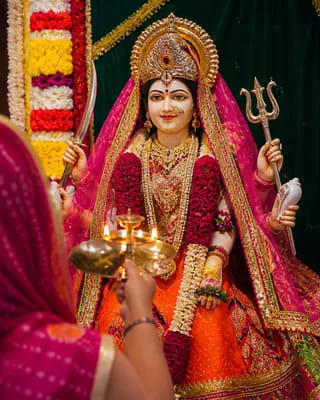
Navratri Begins
About Navratri Begins
Navratri Begins marks the start of the nine-night festival dedicated to Goddess Durga, beginning on the first day of the bright fortnight in the Ashvin month. In Gujarat, this is the most awaited festival.
The festival begins with Ghatasthapana where a kalash is installed and the goddess is invoked. Families set up temples at home and communities prepare for nine nights of devotion and dance.
Gujarati Navratri is world-famous for its Garba and Dandiya Raas dances. Communities organize Garba events where men and women dress in traditional attire and dance through the night.
Each night is dedicated to a different form of Goddess Durga. The festival celebrates the divine feminine power and the triumph of good over evil.
Vrat Vidhi & Fasting Rules
Many devotees observe a nine-day fast, consuming only fruits, milk, and sattvic food.
- Wake early and take a ritual bath.
- Install the kalash and invoke the goddess.
- Observe a fast for nine days.
- Perform daily puja and participate in Garba.
Parana (Breaking Fast) Note: The nine-day fast is broken on Vijayadashami with a grand feast.
Puja Samagri & Ritual Steps
- Clean the puja area and set up the altar.
- Install the kalash with water, mango leaves, and coconut.
- Invoke Goddess Durga with mantras.
- Offer flowers, sweets, and kumkum.
- Perform aarti and distribute prasad.
- Participate in Garba in the evening.
Frequently Asked Questions (FAQs)
Nine nights and ten days, from the first day of Ashvin bright fortnight to Vijayadashami.
A traditional Gujarati dance performed in circles during Navratri, honouring Goddess Durga with rhythmic clapping and traditional music.
Note: All timings are represented in 24-hour notation in local time of the selected location with DST adjustment (if applicable).
Hours which are past midnight are suffixed with next day date. In Panchang, a day starts and ends with local sunrise.
Recommended Pages
Comprehensive annual Hindu calendar with tithis and festivals.
Detailed month-wise view of lunar tithis and celestial events.
Marathi Panchang and festive dates for the year.
Gujarati Vikram Samvat calendar and festivals.
Telugu calendar and festive Panchangam details.
Tamil solar calendar dates and monthly Panchangam.