
Jnana Panchami
JainAlso known as: Jnana 5, Jnana Panchami, Fifth Day of Knowledge
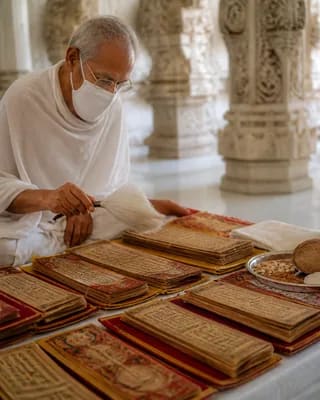
Jnana Panchami
About Jnana Panchami
Jnana Panchami, observed on the fifth day of the bright fortnight in the month of Kartik (October–November), is a sacred day dedicated to the worship of knowledge (jnana) in Jainism. The day honours the five types of knowledge that are central to Jain philosophy: Mati (sensory knowledge), Shruti (scriptural knowledge), Avadhi (clairvoyance), Manahparyav (telepathy), and Kevala (omniscience).
Jainism places supreme importance on knowledge as the pathway to liberation. The Tirthankaras attained omniscience through rigorous spiritual practice and the cultivation of these five forms of knowledge. On Jnana Panchami, Jains worship the scriptures, the acharyas (spiritual teachers), and the principle of knowledge itself. Temples hold special ceremonies where the sacred texts are reverentially displayed and worshipped.
The day is observed with fasting, meditation, and the study of Jain scriptures. Devotees recite the Namokar Mantra and other prayers that glorify the five types of knowledge. Special discourses on Jain philosophy and epistemology are organised in temples and community centres. The observance reinforces the Jain belief that true knowledge — not mere intellectual understanding but direct spiritual perception — is the key to liberation from the cycle of birth and death.
Vrat Vidhi & Fasting Rules
Jnana Panchami is observed with fasting, worship of sacred texts, meditation, and study of Jain philosophy and the five types of knowledge.
- Observe fasting or simple eating on this sacred day.
- Visit the temple and participate in the worship of sacred texts.
- Study the Jain scriptures and reflect on the five types of knowledge.
- Recite the Namokar Mantra and prayers glorifying jnana (knowledge).
- Attend discourses on Jain philosophy and epistemology.
Frequently Asked Questions (FAQs)
The five types are: Mati (sensory knowledge), Shruti (scriptural knowledge), Avadhi (clairvoyance), Manahparyav (telepathy), and Kevala (omniscience).
Jainism teaches that right knowledge (samyak jnana) is one of the three jewels of Jain practice. True knowledge — direct spiritual perception — leads to the destruction of karmic bonds and liberation.
Note: All timings are represented in 24-hour notation in local time of the selected location with DST adjustment (if applicable).
Hours which are past midnight are suffixed with next day date. In Panchang, a day starts and ends with local sunrise.
Recommended Pages
Comprehensive annual Hindu calendar with tithis and festivals.
Detailed month-wise view of lunar tithis and celestial events.
Marathi Panchang and festive dates for the year.
Gujarati Vikram Samvat calendar and festivals.
Telugu calendar and festive Panchangam details.
Tamil solar calendar dates and monthly Panchangam.