
Anant Chaturdashi
festivals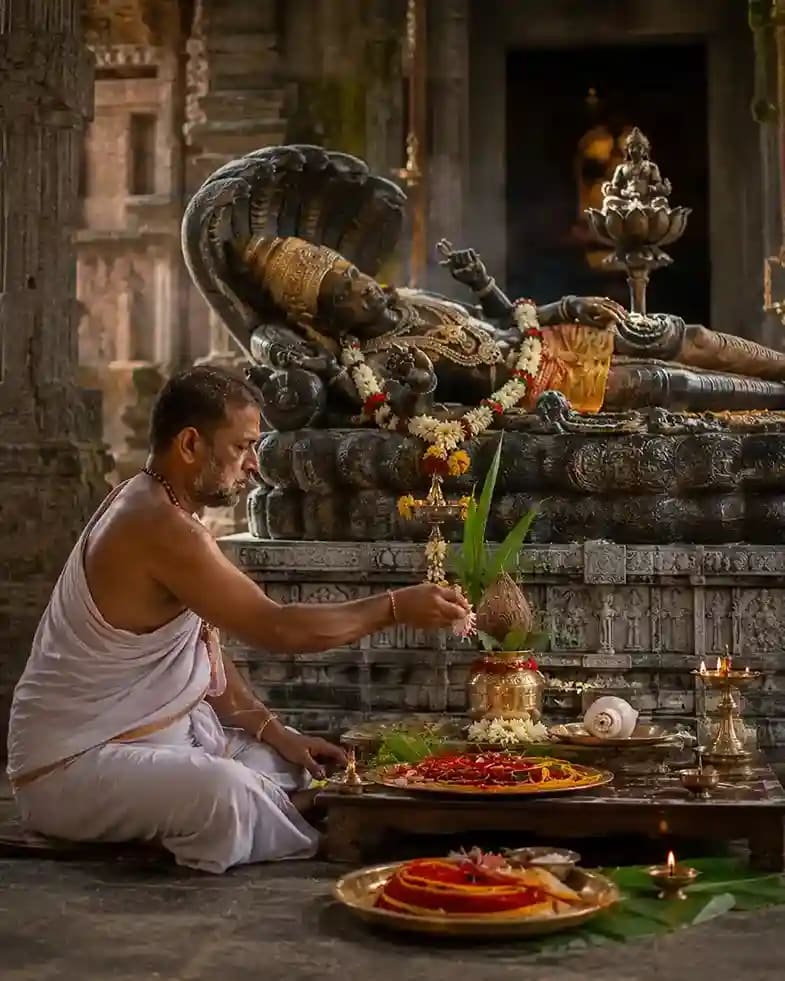
Anant Chaturdashi
Anant Chaturdashi at a Glance
Anant Chaturdashi is fixed by the lunar calendar to Bhadrapada Shukla Chaturdashi, the 14th tithi of the waxing (Shukla) fortnight of Bhadrapada.
- Tithi rule
- Bhadrapada Shukla Chaturdashi (Purnimanta)Shukla ChaturdashiBhadrapada month
- Tithi swami and group
- Shiva · Rikta Tithi
About Anant Chaturdashi
Anant Chaturdashi is observed on the Shukla Paksha Chaturdashi of the Bhadrapada month and is one of the most spiritually significant days in the latter half of the year. The word 'Anant' refers to the infinite, eternal form of Lord Vishnu as Shesha Naga, the divine serpent upon whom the universe rests. On this day, Lord Vishnu is worshipped in His Anant form, the boundless, all-pervading protector who sustains creation and grants liberation from the endless cycle of karma.
In Maharashtra, Gujarat, and other western states, Anant Chaturdashi is renowned for the sacred Anant Sutra ceremony. Married women and householders tie a consecrated silk or cotton thread, knotted fourteen times and dyed with turmeric, around the right wrist or upper arm. The fourteen knots represent the fourteen worlds of creation and serve as a protective talisman believed to shield the wearer from misfortune, illness, and poverty throughout the year.
The festival also coincides with Ganesh Visarjan, the grand culmination of Ganesh Chaturthi. On this day, beautifully adorned idols of Lord Ganesha are carried in exuberant processions with music and dance to rivers, lakes, or the sea, where they are immersed with the chant 'Ganapati Bappa Morya, Pudhchya Varshi Lavkar Ya!' ('O Lord Ganesha, come again early next year!'). This immersion symbolizes the return of the divine to its cosmic source and the transient nature of all material forms.
Vrat Vidhi & Fasting Rules
Anant Chaturdashi fasting and Puja are performed to invoke Lord Vishnu's infinite protection, prosperity, and freedom from karmic bondage.
- Observe a day-long fast, abstaining from grains, beans, and non-satvik foods; fruits, milk, and water are permitted if a full fast is difficult.
- Prepare the Anant Sutra: a thread dyed with turmeric and tied with fourteen knots, each representing one of the fourteen Lokas.
- Place an image or idol of Lord Vishnu reclining on Shesha Naga on a clean altar and offer yellow flowers, Tulsi leaves, fruits, and sweets.
- Recite the Anant Chaturdashi Vrat Katha and chant Vishnu Sahasranama or 'Om Anantaya Namah'.
- Tie the Anant Sutra on the right wrist of male family members and the left wrist of female family members while chanting protective mantras.
- Perform Ganesh Visarjan with reverence, offering final Aarti, flowers, and sweets before immersing the idol in clean flowing water.
Parana (Breaking Fast) Note: The fast is broken on the following day, Purnima, after morning Puja, bathing, and distribution of Prasad.
Puja Samagri & Ritual Steps
- Clean the Puja area and install an image of Lord Vishnu reclining on Shesha Naga.
- Apply turmeric paste to the Anant Sutra and consecrate it with mantras and incense smoke.
- Offer Panchamrit Abhishekam or simple ceremonial bathing to the deity.
- Worship with yellow flowers, Tulsi leaves, incense, lamp, and Naivedya of sweets.
- Tie the Anant Sutra on the wrists of family members while reciting the Anant Stotra.
- Read the Anant Chaturdashi Katha and conclude with Aarti and Prasad distribution.
Vrat Katha: The Story of Sushila and the Infinite Lord
There once lived a virtuous Brahmin named Sumant who had a devoted wife named Diksha and a beautiful daughter named Sushila. After Diksha's untimely death, Sumant married a woman named Karkash who was cruel and unkind to Sushila.
Unable to bear the torment, Sushila left home with her father. On their journey, they encountered the sage Kaundinya performing a sacred fire ritual. Sushila respectfully circumambulated the fire and offered her prayers.
Impressed by her piety, Sage Kaundinya married Sushila. However, soon after their marriage, Kaundinya noticed the Anant Sutra that Sushila wore and arrogantly tore it off, throwing it into the fire, declaring that only fools believed in such superstitions.
Immediately, the couple was plunged into severe poverty and misfortune. Realizing his grave mistake, Kaundinya undertook a long and arduous penance to please Lord Anant. After many trials, he finally saw a vision of the infinite Lord Vishnu, who blessed him and restored the family's wealth and happiness.
Lord Anant instructed that whoever faithfully observes the Anant Chaturdashi Vrata and wears the Anant Sutra will be protected from all calamities and blessed with prosperity, progeny, and spiritual peace.
Anant Chaturdashi: Frequently Asked Questions
Bhadrapada Shukla Chaturdashi; its swami is Shiva, a Rikta Tithi.
Anant Chaturdashi is the day when Ganesh idols installed during Ganesh Chaturthi are immersed (Visarjan), marking the conclusion of the ten-day festival.
The fourteen knots symbolize the fourteen Lokas or worlds of creation governed by Lord Vishnu's infinite form, Anant Shesha.
Yes, anyone seeking Lord Vishnu's protection, prosperity, and freedom from obstacles can observe this Vrata and wear the Anant Sutra.
Note: times are shown with their date; a Panchang day runs from sunrise to sunrise.
Recommended Pages
Comprehensive annual Hindu calendar with tithis and festivals.
Detailed month-wise view of lunar tithis and celestial events.
Marathi Panchang and festive dates for the year.
Gujarati Vikram Samvat calendar and festivals.
Telugu calendar and festive Panchangam details.
Tamil solar calendar dates and monthly Panchangam.