
Radha Ashtami
festivalsAlso known as: Radhashtami
Quick Overview
- Date in 2026
- Friday, September 18, 2026
- Tithi
- Bhadrapada Shukla Ashtami (Purnimanta)
- Tithi begins / ends
- 01:02 PM, Sep 18 to 03:28 PM, Sep 19
- Lunar month
- Bhadrapada · Shukla Paksha
- Also on this tithi
- Mahaluxmi Vrata begins
Radha Ashtami
Friday, September 18, 2026
Lunar Month: Bhadrapada
Radha Ashtami at a Glance
Radha Ashtami is fixed by the lunar calendar to Bhadrapada Shukla Ashtami, the 8th tithi of the waxing (Shukla) fortnight of Bhadrapada.
- Tithi rule
- Bhadrapada Shukla Ashtami (Purnimanta)Shukla AshtamiBhadrapada month
- Tithi swami and group
- Shiva · Jaya Tithi
- Also on this tithi
- Mahaluxmi Vrata begins
Panchanga on This Day
Radha Ashtami · Sep 18, 2026
About Radha Ashtami
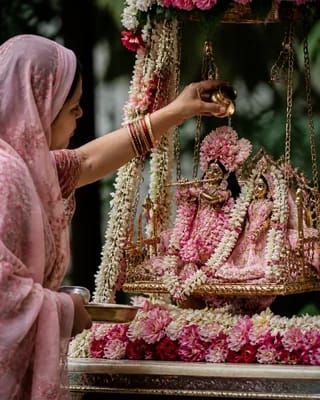
Radha Ashtami, also known as Radhashtami, celebrates the divine appearance day of Radha Rani, the eternal consort and beloved of Lord Krishna and the supreme goddess of the Gaudiya Vaishnava and many other Vaishnava traditions. She is revered as the personification of pure, selfless divine love (prema-bhakti) and the internal potency (hladini-shakti) of Krishna.
Observed on the Ashtami (eighth day) of the Shukla Paksha in the lunar month of Bhadrapada, Radha Ashtami falls approximately fifteen days after Krishna Janmashtami. In the sacred Braj region—especially in Barsana, Vrindavan, and Radha Kund—the day is marked by elaborate temple decorations, noontime abhisheka, grand processions, and ecstatic kirtans glorifying the divine couple.
Radha Rani is not merely a gopi; in Vaishnava theology she is the source of all devotional mellows (rasa) and the ideal of selfless surrender. Worshipping her is considered the quickest path to attracting Krishna’s mercy, for Krishna is controlled by the love of his devotees, and Radha is the crown jewel of such devotion.
Vrat Vidhi & Fasting Rules
Devotees fast, worship Radha-Krishna together, and immerse themselves in kirtan and hearing her glories.
- Begin the day before dawn with a holy bath and take the sankalpa to observe the fast according to your capacity (fruit/milk fast or nirjala).
- Thoroughly clean the altar and install or visualize the deity forms of Sri Sri Radha-Krishna, preferably in the mood of divine paramour love.
- Offer a special noontime abhisheka with panchamrit, scented water, milk, yogurt, honey, and ghee.
- Adorn the deities with new yellow or red garments, flower garlands, and Radha’s favorite ornaments.
- Chant the Radha Sahasranama, Radha Gayatri, or the Hare Krishna maha-mantra, and read or listen to the Radha Ashtami Katha.
- Prepare bhoga of kheer, malpua, panjiri, fresh fruits, and tulasi leaves, and offer it with love.
- Break the fast after performing evening arati and distributing prasad, ideally after the Ashtami tithi ends.
Puja Samagri & Ritual Steps
- Place the Radha-Krishna deities on a clean altar and invoke their presence.
- Perform abhisheka with panchamrit followed by pure water and wipe gently.
- Dress the deities in fresh clothes and apply sandalwood paste, kumkum, and ornaments.
- Offer flowers, Tulasi leaves, incense, lamp, and rotating aarti.
- Offer the prepared bhoga and conclude with prayers for prema-bhakti.
- Distribute prasad and circumambulate the altar while chanting Radha’s names.
Vrat Katha: The Appearance of Radha Rani
Long ago, in the sacred land of Barsana, King Vrishabhanu found a radiant baby girl lying on a lotus flower in the Yamuna river. The infant had closed her eyes, and despite everyone’s efforts, she would not open them.
Vrishabhanu and his queen Kirti took her home and raised her with immense love. When the infant Krishna, son of Nanda Maharaja, was brought to meet her, the baby girl at last opened her lotus eyes and gazed only at Krishna. From that moment, she became known as Radha, the one who worships Krishna with the highest devotion.
The sages and demigods rejoiced, recognizing that the divine couple had descended to perform their eternal pastimes in Vraja. Radha’s love, purity, and compassion became the living scripture of bhakti for all souls seeking Krishna.
Radha Ashtami: Frequently Asked Questions
Bhadrapada Shukla Ashtami; its swami is Shiva, a Jaya Tithi.
Shukla Ashtami: 01:02 PM, Fri, Sep 18, 2026 to 03:28 PM, Sat, Sep 19, 2026 (IST).
Mahaluxmi Vrata begins, also on Bhadrapada Shukla Ashtami.
No. While especially prominent in Gaudiya Vaishnavism, Radha Ashtami is celebrated across many Vaishnava traditions, especially in the Braj region of Uttar Pradesh.
Radha is Krishna’s internal pleasure potency and supreme devotee; their relationship represents the highest form of selfless divine love.
Yes, anyone seeking pure devotion and spiritual advancement may observe Radha Ashtami with sincerity.
Festivals in the Same Lunar Month
Bhadrapada
Note: times are shown with their date; a Panchang day runs from sunrise to sunrise.
Recommended Pages
Comprehensive annual Hindu calendar with tithis and festivals.
Detailed month-wise view of lunar tithis and celestial events.
Marathi Panchang and festive dates for the year.
Gujarati Vikram Samvat calendar and festivals.
Telugu calendar and festive Panchangam details.
Tamil solar calendar dates and monthly Panchangam.